Back to List
Hayabusa2#
#: Small Hazardous Asteroid Reconnaissance Probe
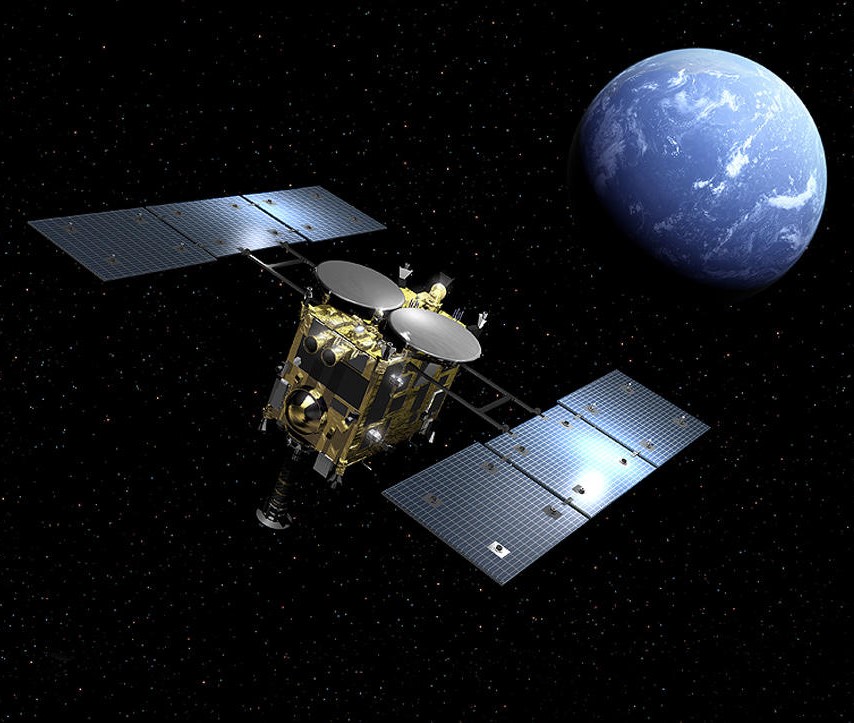
「はやぶさ2」は2020年12月に地球帰還後,カプセルを分離して,また新たな深宇宙の旅へと飛び立ちました.現在は,半分近く残ったイオンエンジンの燃料(キセノン)を活用し,拡張ミッションを開始しています.
After returning to the Earth in December 2020, Hayabusa2 separated the sample capsule and left for a new journey into deep space. The Extended Mission will use the remaining ion engine fuel (Xenon), of which about half currently remains.
Mission Brief
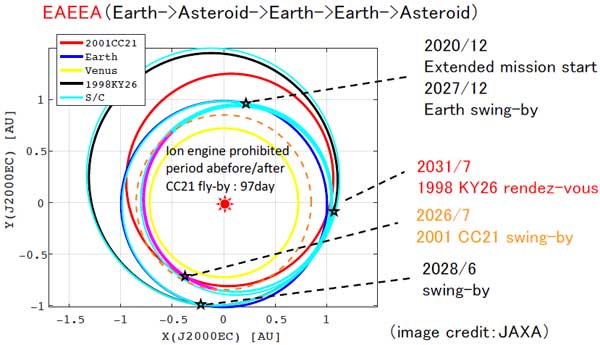
「はやぶさ2」は2020年12月に地球帰還後,カプセルを分離して,また新たな深宇宙の旅へと飛び立ちました.現在は,半分近く残ったイオンエンジンの燃料(キセノン)を活用し,拡張ミッションを開始しています.次の目標は1998 KY26という小惑星で,到着は2031年.その間,2026年に小惑星2001 CC21へのフライバイや,2027年,2028年には2回の地球スイングバイを予定しています.
この拡張ミッションの最終目標天体である1998 KY26は,直径数10mというとても小さな天体で,自転周期10分という非常に早い自転速度から,高速自転小惑星(Fast Rotator)と呼ばれます.「小さくて,回転が速い」という特性が,小惑星表面付近で非常に特殊な物理環境を生み出します.自転による遠心力が小惑星の重力に優っているのです.このような環境にターゲットマーカを落とした時,どのような振る舞いをするのか,既に科学的興味が尽きません.未だかつて人類が到達したことのない特徴の天体であり,リュウグウとの比較観測により,リュウグウで得られた科学的知見がより深められると期待されています.
また,このようなサイズの小惑星は,宇宙空間に多数存在しており100~1000年に1度の頻度で地球に衝突し,大きな被害を与える可能性のある天体と考えられていますが,地上からの観測では詳細なことまでは明らかになっていません.「はやぶさ2」が探査し,その物理特性や近傍での運用方法を確立することによって,このような天体に対する知見を深め,地球衝突に対する対策を立てる上での有益な知識を獲得することができると考えています.
さらに,2026年に予定している,小惑星2001 CC21への近接フライバイでも,Planetary Defenseに資する技術実証を計画しています.「はやぶさ2」に搭載されているカメラで意味のあるサイエンスデータを取得するため,衝突しないギリギリの距離まで小惑星に接近する必要があり,小惑星相対の高い軌道誘導精度が求められます.小惑星そのものの軌道に不確定性があるため,光学航法が不可欠であるにも関わらず,小惑星は地球や金星などの惑星に比べて暗いため,フライバイの数日前でなければ視えてきません.このように,相手が小惑星ならではの航法誘導の難しさがある中で,ギリギリの距離で小惑星を掠め飛んでいく運用は,探査機を小惑星に衝突させる軌道誘技術と同義であると考えられます.Planetary Defenseの中では,地球への衝突を回避させるため,探査機を小惑星に当てることで軌道を変更するような対策も検討されており,「はやぶさ2」の近接フライバイは,このような対策に直接的に貢献できる技術となっています.
以上のように,「はやぶさ2」の拡張ミッションでの活動は,Planetary Defenseにも大きく貢献することが期待されます.ミッションの意義は非常に大きく,だからこそミッションを成功させるために求められる課題は多岐に渡ります.例えば,2026年の小惑星のフライバイでどこまで小惑星に肉薄できるのか,2031年,ターゲットマーカが置けない小惑星の表面にどうやって近付くのか,そもそも10年間の運用計画をどうするのか,検討すべきことは山積みです.幸運にも,我々にはこれらのミッションを実施するまでに,まだ十分な時間が残されています.この時間の中で,上述のような非常に興味深い課題に,将来活躍が期待される若手技術者たちが,探査の経験者と共に取り組もうとしています.「はやぶさ2」の拡張ミッションは,経験者と若手が同じ問題に取り組みながら技術継承をしていくことができる貴重な環境にもなっており,探査ミッションに関わる人材を育成していく土壌としての重要な役割も担っているのです.
After returning to the Earth in December 2020, Hayabusa2 separated the sample capsule and left for a new journey into deep space. The Extended Mission will use the remaining ion engine fuel (Xenon), of which about half currently remains. The next target destination is asteroid 1998 KY26 and arrival is scheduled for 2031. During the journey, a flyby is planned of asteroid 2001 CC21 in 2026, and two Earth swing-bys in 2027 and 2028.
The final destination for the Extended Mission, 1998 KY26, is a very small object with a diameter of several tens of meters. The asteroid is part of a class referred to as fast rotating asteroids due to its extremely rapid rotation time of just 10 minutes. The “small and fast” attribute creates a very special physical environment near the asteroid’s surface, as the centrifugal force due to the rotation exceeds the gravity of the asteroid. How a target marker behaves when dropped in such an environment will be a scientifically interesting test. The characteristics of this type of celestial body have not been explored by humankind before, and the comparative observations with asteroid Ryugu are expected to deepen the scientific knowledge obtained at Ryugu.
Moreover, many asteroids of this size exist in outer space and are anticipated to collide with the Earth at a cadence of once every 100 to 1000 year, causing significant damage. However, ground-based observations are not able to reveal the details of these asteroids. Exploration with Hayabusa2 to establish both the physical characteristics of these asteroids and operation methods in the vicinity is expected to deepen knowledge about this asteroid class and provide us with useful information for designing countermeasures against an Earth collision.
The proximity flyby of asteroid 2001 CC21 scheduled for 2026 will be an additional technology demonstration that will contribute to Planetary Defense. To acquire meaningful science data with the camera onboard Hayabusa2, the spacecraft must approach as close as possible to the asteroid without a collision, and high orbit guidance accuracy relative to the asteroid is required. While optical navigation is essential due to the uncertainty in the asteroid’s orbit, asteroids are darker than planets such as the Earth and Venus, and can only be seen a few days before the flyby. The unique difficulties presented by the last minute navigation guidance for an asteroid mean that the flyby operation is similar to orbit-inducing technologies used to collide a spacecraft with an asteroid. Measures to change the orbit of an asteroid through collision with a spacecraft are being considered at a method of Planetary Defense to avoid a future Earth impact. The technology required for the flyby of Hayabusa2 can therefore directly contribute to the development of these measures.
As described above, the activities during the Hayabusa2 Extended Mission are expected to make notable contributions to Planetary Defense. This makes the significance of the mission enormous, and also explains why the challenges required for success are so diverse. For example, among the points to consider is how close the 2026 asteroid flyby can be, how the surface of the asteroid can be approached in regions where a target marker cannot be place, and what needs to be done during the ten year operation plan. Fortunately, we still have plenty of time to plan these operations. Over this period, junior engineers who it is hoped will take on future active roles, are attempting to tackle the above mentioned interesting challenges together with colleagues who have experience in exploration. The Hayabusa2 Extended Mission is a valuable environment where both experienced and junior researchers can work together on the same issues and pass on their skills. This forms an important basis for developing the human component of exploration missions.