Back to List
Hayabusa2
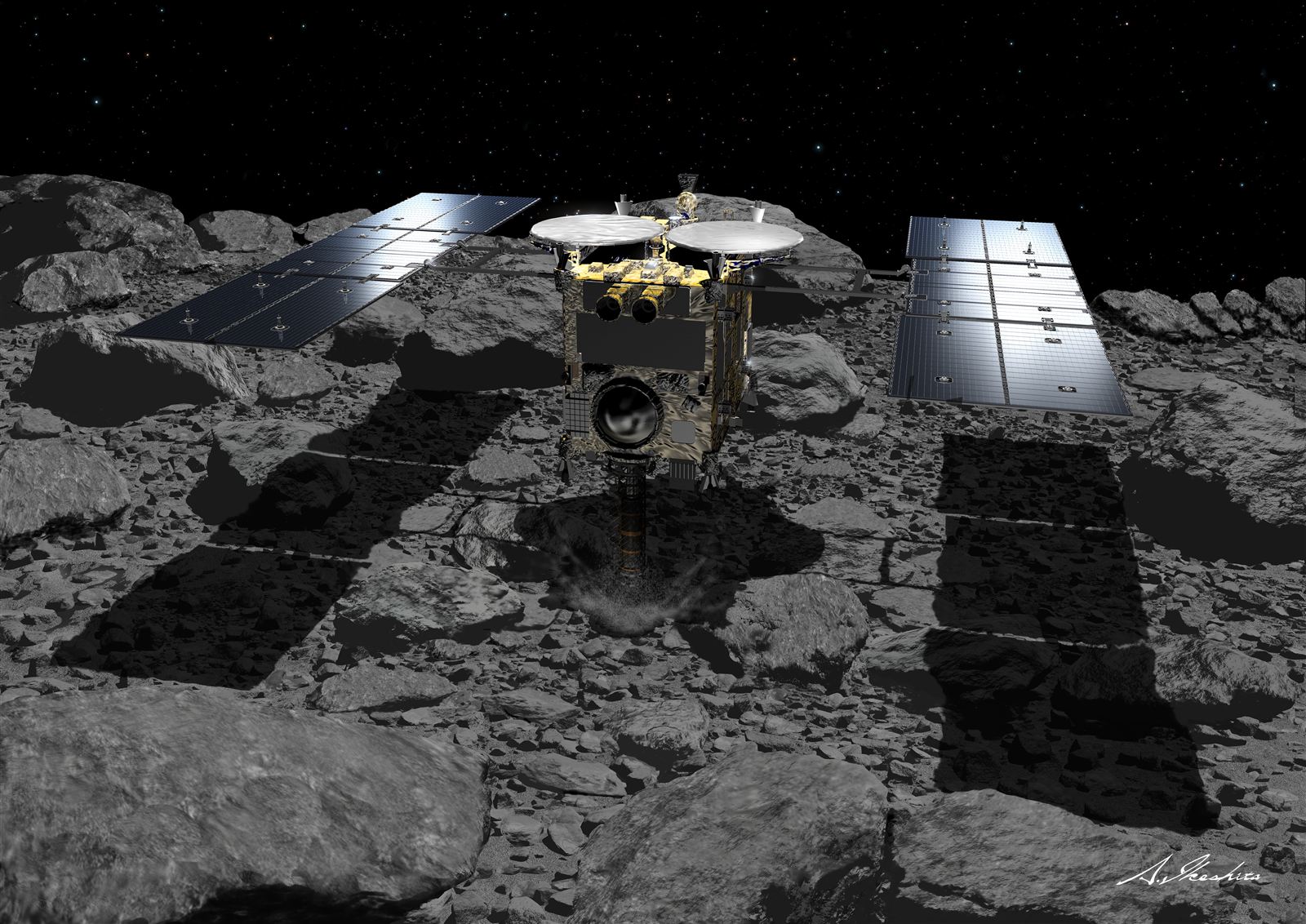
「はやぶさ」後継機として小惑星サンプルリターンを行う小惑星探査機.「はやぶさ」が探査した小惑星イトカワ(S型)とは別の種類の小惑星(C型)を探査することで,惑星の起源だけでなく地球の海の水の起源や生命の原材料をも探求します.
Asteroid Explorer “Hayabusa2” is a mission to clarify the origin and evolution of the Solar System, including the beginnings of life. The mission also aims to establish deep space exploration technology though taking on new challenges.
Mission Brief
「はやぶさ2」は、基本的には「はやぶさ」で行ったサンプルリターン方式を踏襲しました.ただし、より確実にミッションを行えるよう、信頼性を高める様々な改良が加えられました.またその一方で、小惑星表面に人工的なクレーターを作り、地下のサンプルを持ち帰るといった、新しい技術を使ったミッションにも挑戦しました.太陽系天体探査技術を向上させることも、「はやぶさ2」の重要な目的です.
「はやぶさ2」の目標天体であった小惑星リュウグウ (162173)はC型の小惑星ですが、太陽系が生まれた頃(今から約46億年前)の水や有機物が、今でも残されていると考えられています.地球の水はどこから来たのか、生命を構成する有機物はどこでできたのか.そのような疑問を解くのが「はやぶさ2」の目的です.また、最初にできたと考えられる微惑星の衝突・破壊・合体を通して、惑星がどのように生まれたのかを調べることも「はやぶさ2」の目的です.つまり、「はやぶさ2」は、太陽系の誕生と生命誕生の秘密に迫るミッションなのです.
]
「はやぶさ2」は、2018年6月27日にリュウグウに到着、2019年に2回のタッチダウンによって試料を回収し、2020年12月6日に無事に地球に試料が入ったカプセルを届けました.「はやぶさ2」探査機は現在拡張ミッションへ移行し、小惑星1998 KY26に接近して観測を行うことが計画されています.
This asteroid mission is the sequel to the Hayabusa spacecraft, designed for returning asteroid samples. By investigating a different type of asteroid (type C) from the Itokawa asteroid (type S) that was the target of Hayabusa, Hayabusa2 will explore not only the origins of the planets, but also the origin of the water of Earth’s oceans and the source of life.
Hayabusa2 primarily followed the sample return method performed by the first Hayabusa mission. However, a series of improvement were implemented to increase reliability so that the mission was able to obtain greater accuracy and reliability. The mission also took on additional challenges using new technology, such as that for creating an artificial crater on the asteroid surface and collecting a sample of the subsurface material. Improving spacecraft technology for exploring astronomical objects within the Solar System is an important goal for the Hayabusa2 mission.
Hayabusa2 examined asteroid (162173) Ryugu. Ryugu is a type C asteroid and it is believed that the composition of such asteroids still include organic matter and water from when the Solar System was forming, roughly 4.6 billion years ago. The second goal of the Hayabusa2 mission is to investigate questions regarding the origin of the Earth’s water and where the organic matter that forms life originally came from. Another aspect of the mission is to examine how the planets formed through the collision, destruction, and combination of planetesimals, which are thought to have been formed early in the Solar System. In short, Hayabusa2 is a mission designed to elucidate the creation of life and the birth of the Solar System.
Hayabusa2 arrived at Ryugu on June 27, 2018, collected samples from the asteroid during two touchdowns in 2019, and delivered the sample capsule back to the Earth on December 6, 2020. After delivering the capsule, the spacecraft continued on to a new mission. This new phase is referred to as the “Extended Mission”, with a new target destination of the small asteroid, 1998 KY26. This is a long-term mission whose duration exceeds 10 years over which there is an itinerary of events followed by the rendezvous with the rapidly rotating 1998 KY26.