Back to List
Deployment Analysis of Multifunctional Membrane Structures
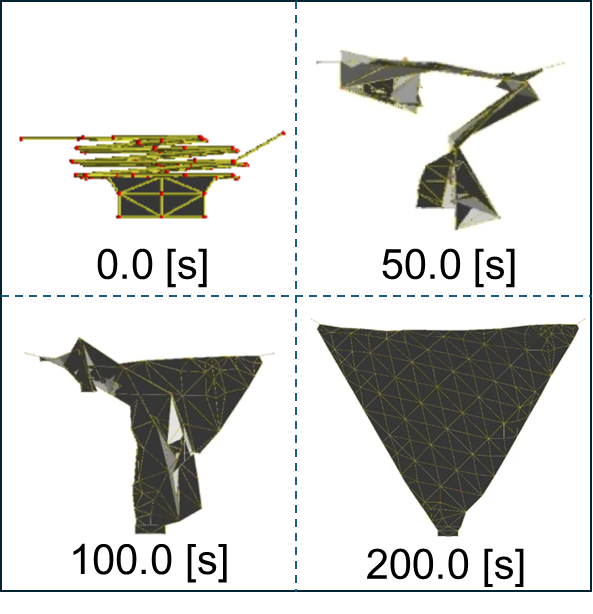
本研究は,軌道上で展開する膜構造物の展開挙動を事前予測・事後検証することが目的である.薄膜構造物はその特性から重力・大気抵抗の影響を受けやすいため,地上での展開再現が困難であり,数値解析による事前予測・安全評価が必要となる.本研究では,軌道上実証ミッション「HELIOS-R」の展開ダイナミクスを検証し,将来の大型薄膜構造物に向けた設計指針の提示を目指している.
The objective of this research is to predict in advance and verify after the fact the deployment behavior of membrane structures that unfold in orbit. Because thin-film structures are, by their nature, easily affected by gravity and atmospheric drag, reproducing their deployment on the ground is difficult, making prior prediction and safety evaluation by numerical analysis necessary. In this research, we verify the deployment dynamics of the on-orbit demonstration mission "HELIOS-R" and aim to present design guidelines for future large-scale membrane structures.
Abstract
近年,宇宙機において大面積かつ軽量な膜構造物を利用する技術が注目されている.膜構造物は高い収納効率を有し,打上げ時には小型フェアリングに格納できる一方,軌道上では大面積へ展開することが可能である.しかし,薄膜は柔軟性が高く,展開過程において曲げや捻じれ・座屈が生じやすい.この強い非線形性ゆえに,展開解析の数値計算には膨大な時間を必要とする.そこで,本研究では膜面をばね・ダンパに置き換えることで計算コストを低減できる,多粒子法(Multi-Particle Method)を用いた展開解析を行っている.
薄膜構造物は重力・大気抵抗の影響から,地上実験による高精度な展開再現が困難である.そこで,本研究では2026年2月13日に膜展開運用に成功した,軽量膜展開構造物「HELIOS-R」のフライトデータを活用し,展開ダイナミクスの解明や多粒子モデルの評価を行っている.
本研究の成果により,展開信頼性の向上や膜面上への適切なデバイス配置設計が可能となり,次世代のソーラー電力セイルおよび薄膜構造物の多機能化に貢献する.
In recent years, technology that uses large-area, lightweight membrane structures on spacecraft has been attracting attention. Membrane structures have high packing efficiency: they can be stowed in a small fairing at launch, while in orbit they can be deployed to a large area. However, thin films are highly flexible and are prone to bending, twisting, and buckling during the deployment process. Because of this strong nonlinearity, the numerical computation of deployment analysis requires an enormous amount of time. Therefore, in this research we perform deployment analysis using the Multi-Particle Method, which can reduce computational cost by replacing the membrane surface with springs and dampers.
Because thin-film structures are affected by gravity and atmospheric drag, reproducing their deployment with high accuracy through ground experiments is difficult. In this research, we therefore make use of the flight data of the lightweight deployable membrane structure "HELIOS-R," which successfully carried out its membrane deployment operation on February 13, 2026, to elucidate the deployment dynamics and to evaluate the multi-particle model.
The results of this research enable improved deployment reliability and appropriate device placement design on the membrane surface, contributing to the multifunctionalization of next-generation solar power sails and thin-film structures.