Back to List
Optical Navigation for Deep-Space Rendezvous and Docking
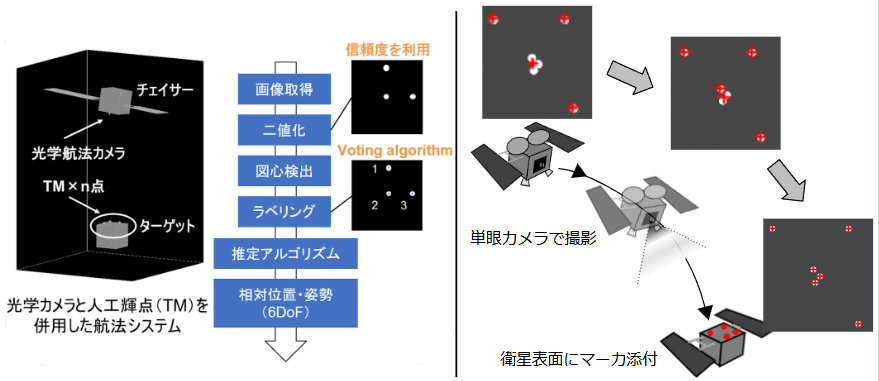
深宇宙におけるランデブードッキングを,カメラ撮影による画像情報だけで実現可能にすることが本研究の目的である.このとき,取得した画像からどのように情報を抽出し利用するかが鍵となる.未踏の天体付近において,種々の光学外乱への耐性を持ちながら高精度に相対位置・姿勢を推定するための画像処理・推定手法の開発に取り組んでいる.
The objective of this research is to make rendezvous and docking in deep space achievable using only the image information captured by a camera. Here, the key lies in how information is extracted from the acquired images and put to use. In the vicinity of unexplored celestial bodies, we are developing image-processing and estimation methods to estimate the relative position and attitude with high accuracy while maintaining robustness against various optical disturbances.
Abstract
これまでの光学航法は,背景の星などの外乱点を除去するために様々な機器を搭載し,航法輝点となるマーカがぼやけて1つに見えないように十分接近してから実施されてきた.しかし,重量制約が厳しい深宇宙でミッションの自在性を向上させるには,必要最低限の機器で遠距離から光学航法を行える必要がある.そのために,外乱点やぼやけたマーカが混在する状況下でも各輝点情報の信頼性を定量的に評価し,カルマンフィルタに組み込むことで,ロバスト推定を実現する.また,「撮れれば推定できる」状況を確保するために,宇宙機が自律的にマーカを観測し続ける必要がある.そこで,複数のマーカという多対象の観測性を向上させながら,それに伴う移動量を最小限に抑える多目的最適化についても検討を進めている.
また,目印となる特定の点を追うのではなく,画像全体のパターンに着目したアプローチも検討している.これは画像を周波数情報に変換し,そのパターンの重なり具合(相関)を解析することで,接近に伴う対象の見かけの「拡大率」を直接導き出す手法である.特定の輝点を探す必要がないため,光の当たり方や複雑な形状の変化に左右されない,より堅牢な観測が可能になる.この計測と宇宙機自身の移動を組み合わせることで,相手の大きさや相対位置等の事前情報を一切必要とせず,正確に相対位置を推定することを目指している.
Conventional optical navigation has carried various instruments to remove disturbance points such as background stars, and has been performed only after approaching closely enough that the markers serving as navigation light points do not blur into a single point. However, to improve the flexibility of missions in deep space, where weight constraints are severe, it is necessary to perform optical navigation from a long distance using the minimum possible equipment. To this end, we quantitatively evaluate the reliability of each light-point measurement even in situations where disturbance points and blurred markers coexist, and incorporate it into a Kalman filter to achieve robust estimation. In addition, to ensure a "if it can be imaged, it can be estimated" situation, the spacecraft must continue to observe the markers autonomously. We are therefore also investigating multi-objective optimization that improves the observability of multiple markers while minimizing the spacecraft motion required to do so.
We are also investigating an approach that focuses on the pattern of the entire image, rather than tracking a specific landmark point. In this method, the image is transformed into frequency information, and by analyzing the degree of overlap (correlation) of the patterns, the apparent "magnification" of the target as it is approached is derived directly. Because there is no need to search for specific light points, more robust observation that is unaffected by lighting conditions or changes in complex shapes becomes possible. By combining this measurement with the spacecraft's own motion, we aim to estimate the relative position accurately without requiring any prior information such as the size or relative position of the target.
