Back to List
Deep-Space Relative Navigation and Guidance in the Mid-to-Far Range
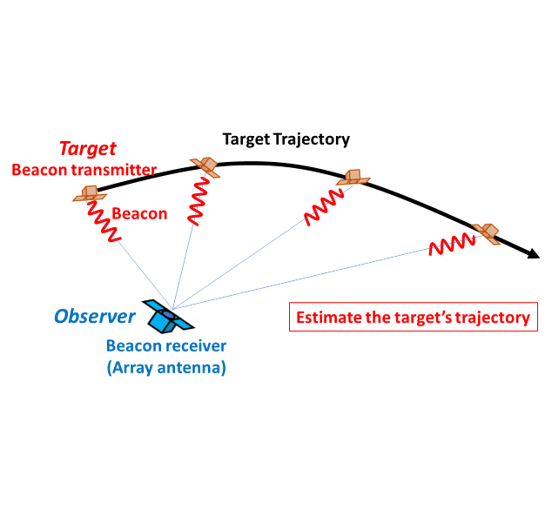
深宇宙において,ターゲットまでの距離が直接得られない中遠方領域から,外部支援に依存することなく探査機が自らランデブーを成立させるための,相対航法・誘導技術を構築する.デブリ除去・小天体探査・有人飛行など,将来の幅広い自律ランデブーミッションを支える基盤技術の確立に貢献することを目指す.
We are building relative navigation and guidance technology that allows a spacecraft to accomplish rendezvous on its own—without relying on external support—starting from the mid-to-far range in deep space, where the distance to the target cannot be obtained directly. We aim to contribute to establishing a foundational technology that supports a wide variety of future autonomous rendezvous missions, including debris removal, small-body exploration, and human spaceflight.
Abstract
深宇宙ランデブーでは,GPSや地上局といった外部情報を十分に活用できないため,チェイサーは自らのセンサだけでターゲットの相対軌道を推定し,誘導を行うことが求められる.しかし,搭載カメラやアンテナから得られるのはチェイサーからターゲットの「方向」だけで,「どれほど離れているか」という奥行きの情報は直接には得られない.奥行き情報を得るには,限られた情報を最大限に活かして軌道を読み解くか,あるいは探査機自身が経路を曲げて視差を稼ぐしかなく,いずれも搭載資源や観測時間の制約のなかで成立させる設計が求められる.
本研究室では,この問題に対して,(A) 観測点数が少なく観測時間も短い厳しい条件下から,後段の精密な軌道推定の出発点となる「性質の良い初期解」を引き出す相対初期軌道推定手法の構築と,(B) オンボードで計算可能であり,初期条件によらず燃料最適な軌道で視差を効率よく稼ぎながら接近する新しい誘導則の構築,という二つのアプローチから取り組んでいる.
In deep-space rendezvous, the chaser cannot make full use of external information such as GPS or ground stations, and is therefore required to estimate the relative orbit of the target and guide itself using only its own sensors. However, the onboard camera and antenna provide only the "direction" from the chaser to the target; the depth information of "how far away" the target is cannot be obtained directly. To obtain depth information, one must either read out the orbit by making the most of the limited information, or have the spacecraft itself bend its path to gain parallax—both of which require a design that works under constraints on onboard resources and observation time.
To address this problem, our laboratory is working from two approaches: (A) constructing a relative initial-orbit determination method that extracts a "well-behaved initial solution"—the starting point for subsequent precise orbit estimation—even under the severe conditions of few observation points and short observation time; and (B) constructing a new guidance law that is computable onboard and that efficiently gains parallax while approaching along a fuel-optimal trajectory regardless of the initial conditions.