Back to List
Scattering in Microgravity
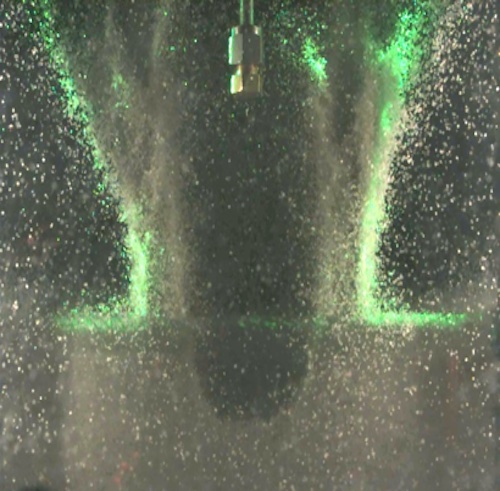
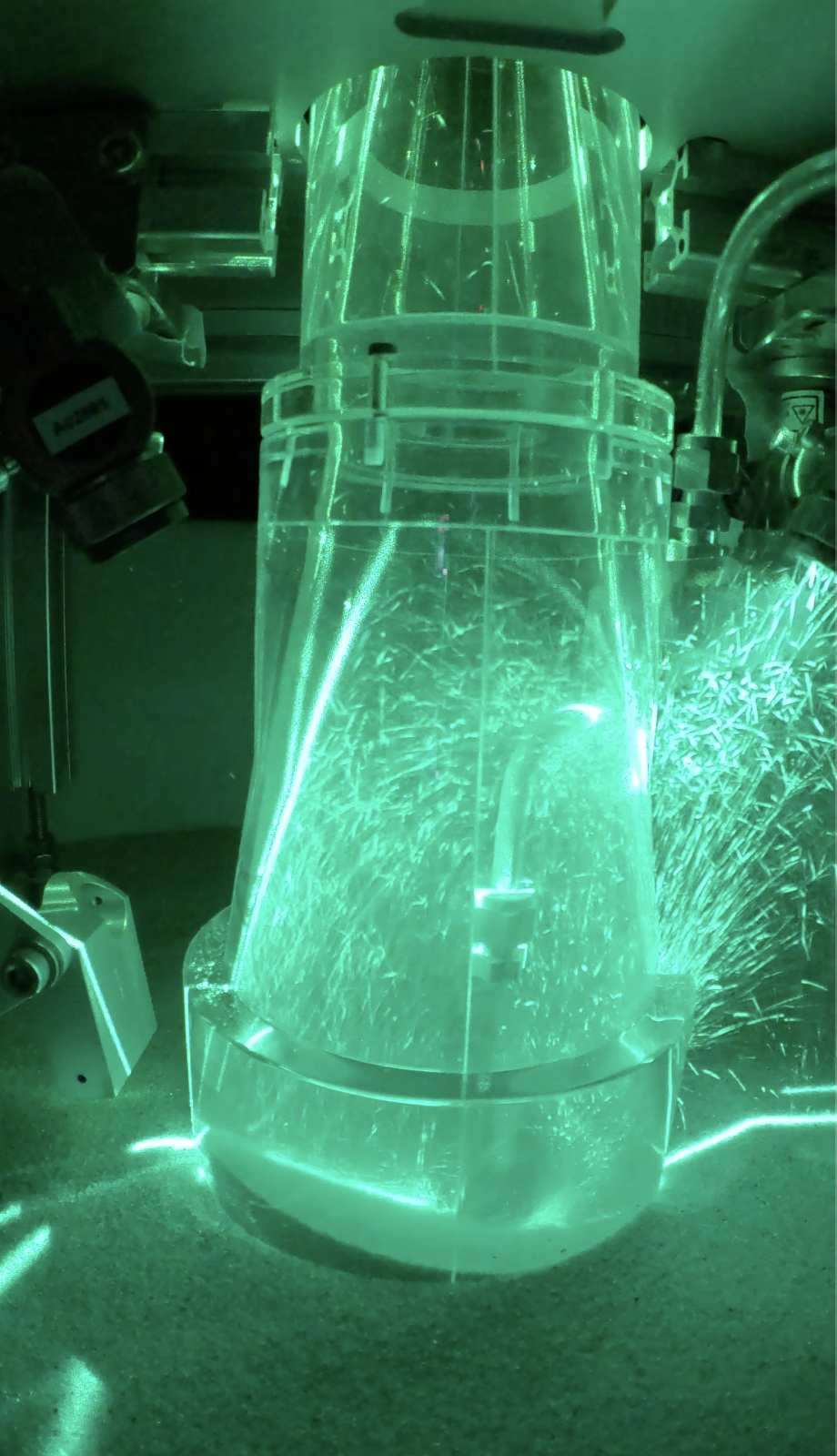
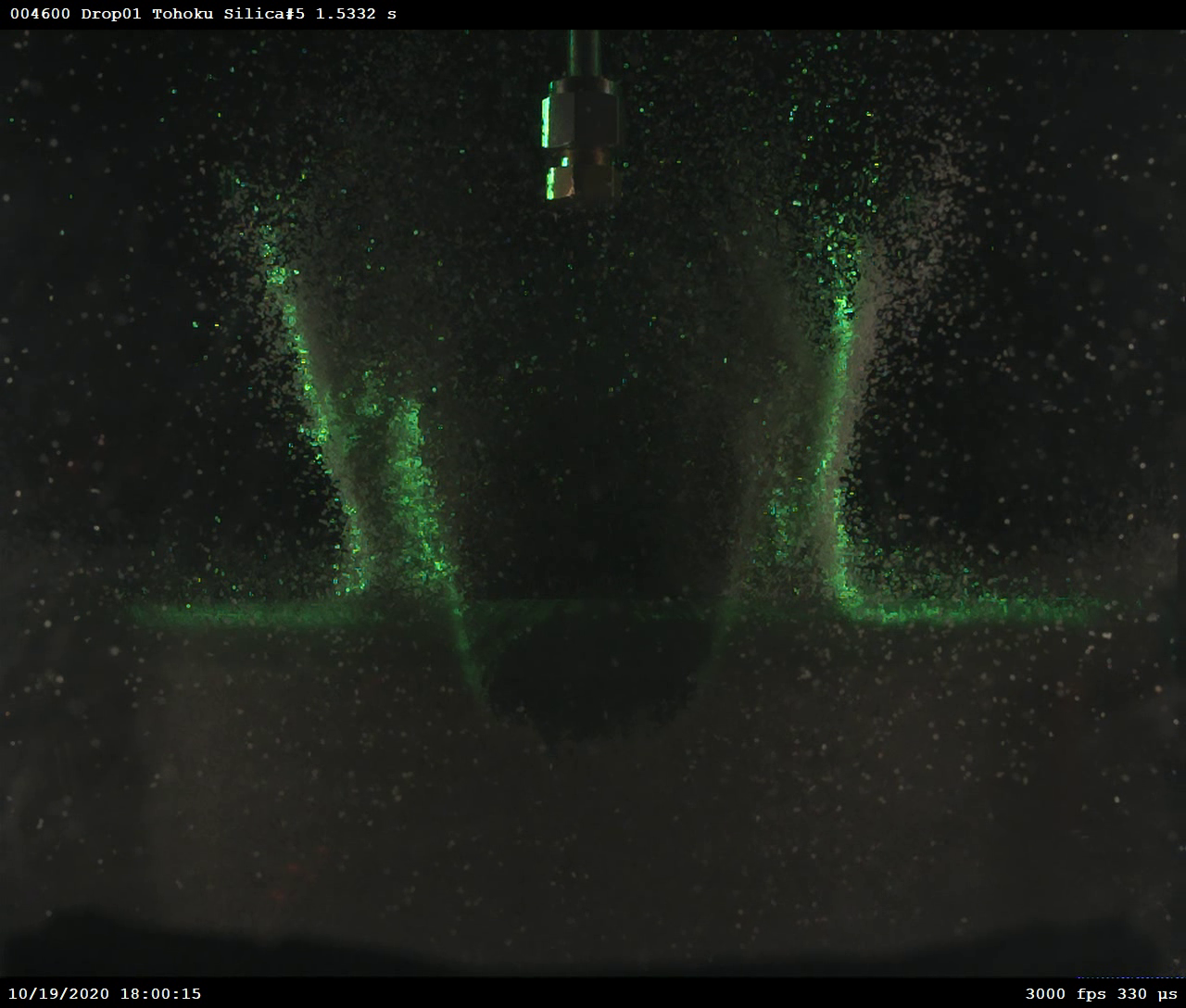
小惑星探査機「はやぶさ2」のタッチダウン時に,小惑星表面の物体が探査機の方向に散乱する現象が確認された.この現象の原因の一つはスラスターの噴射である.物体散乱のメカニズムは,1つのスラスタの巻き上げと,複数のスラスタからのプルームの干渉と考えられている.真空下の模擬土壌にスラスタを噴射し,物体散乱の主原因を調べた.
During the touchdown of the asteroid probe, Hayabusa2, objects on the surface of the asteroid were found to scatter in the direction of the probe. One of the causes of this phenomenon is the injection of thrusters. The mechanism of object scattering is considered to be the wind-up of a single thruster and the interference of plumes from multiple thrusters. The main cause of object scattering is investigated by spraying thrusters into a simulated soil under vacuum.
Abstract
はやぶさ2のタッチダウン時,小惑星表面の物体がはやぶさ2に向かって飛散した.この現象の原因として考えられるのは,はやぶさ2がサンプリング時に小惑星表面に弾丸を射出したこと,及びはやぶさ2が小惑星表面から離脱する際にスラスタを噴射したことである.発射体射出による天体の散乱ははやぶさ2固有の問題であるが,スラスタ射出による天体の散乱は,着陸を含む今後の全てのミッションで増加する可能性が高い.飛散した天体が探査機に衝突すれば,探査機が破壊される可能性がある.また,測距儀や観測機器に付着すれば,ミッション遂行に支障をきたす可能性がある. したがって,スラスターによる天体表面物体の飛散メカニズムや挙動を理解することは非常に重要である.なぜなら,スラスタによって持ち上げられた天体表面物体が探査機に与える影響は,探査機に求められる工学的・物理的成果を大きく低下させ,探査ミッションそのものの成否に大きく影響するからである.
スラスターが物体の表面に巻き上げられる理由は3つ考えられる.1つ目はスラスターが地面にクレーターを掘っていること,2つ目は元々の地形の影響である.3つ目は,複数のスラスターから噴出するスラスタープルームが互いに衝突し,上向きの力が発生することである. スラスタープルームと小惑星レゴリスとの相互作用を調べるために,真空下の模擬土壌にガスを注入する1Gおよび微小重力実験を行う.また,同様の条件でDEM-CFDシミュレーションを行うことで,様々な天体と探査機の組み合わせにおけるタッチダウン時の砂の揚力を再現することを目指す.
The asteroid explorer Hayabusa2 touched down on the asteroid Ryugu twice. During the touchdown of Hayabusa2, some objects on the surface of the asteroid were scattered toward the vehicle. The possible causes of this phenomenon are that Hayabusa2 shot the projectile into the surface of the asteroid when it was sampling, and that Hayabusa2 fired the thruster when it left the surface. Although the scattering of celestial objects due to projectile injection is a unique problem for Hayabusa2, the scattering of celestial objects due to thruster injection is likely to increase in all future missions which includes landings. If the scattering celestial surface objects hit the spacecraft, the spacecraft may be destroyed. In addition, if it adheres to the rangefinder and the observation equipment, it may interfere with the mission execution. Therefore, it is very important to understand the dispersal mechanism and behavior of objects on the surface of a celestial body by thrusters. This is because the impact of surface objects lifted by thrusters on a spacecraft will greatly degrade the engineering and physical results required of the spacecraft, and thus the success or failure of the exploration mission itself will be greatly affected.
There are three possible reasons for the thrusters to be rolled up on the surface of an object. The first is that the thrusters are digging craters in the ground, and the second is the effect of the original terrain. The third is that the thruster plumes from multiple thrusters collide with each other, creating an upward force. We conduct 1G and micro gravity experiments of gas injection into simulated soil under vacuum in order to investigate the interaction between thruster plume and asteroidal regolith. We also aim to reproduce the sand lift during touchdown for various astronomical and spacecraft combinations by performing DEM-CFD simulations for similar conditions.
【ガスサンプリングシステムの開発】
また,ガス(流体)を用いて小天体のサンプルを回収する“ガスサンプリングシステム”が新たなサンプリング方式として提案されている.本システムは,対象小天体にガス(流体)を噴射し,その流れによって表面の粒子を巻き上げることでサンプルを回収する方法である.本研究では,ガス噴流による粒子飛散・輸送現象に着目し,数値流体力学と粒子法を組み合わせたDEM-CFD連成解析を用いて,流体力と粒子挙動の関係を定量的に明らかにする.小天体表面は低重力かつ低圧環境であり,地上とは異なる挙動を示すため,シミュレーションによる再現が必要である.これにより,宇宙空間におけるサンプル回収率の調査,サンプル回収装置の設計指針の高度化に貢献することを目指す.
[Development of a gas sampling system]
In addition, a "gas sampling system" that collects samples from a small body using gas (fluid) has been proposed as a new sampling method. In this system, gas (fluid) is injected toward the target small body, and the resulting flow lifts the particles on the surface to collect a sample. In this research, focusing on the particle scattering and transport phenomena caused by the gas jet, we use a DEM-CFD coupled analysis that combines computational fluid dynamics and a particle method to quantitatively clarify the relationship between fluid forces and particle behavior. Because the surface of a small body is a low-gravity, low-pressure environment and exhibits behavior different from that on the ground, reproduction by simulation is necessary. Through this, we aim to contribute to investigating the sample recovery rate in space and to advancing the design guidelines for sample recovery devices.