Back to List
Reliable and High-Precision Spacecraft Control Considering Thruster Errors
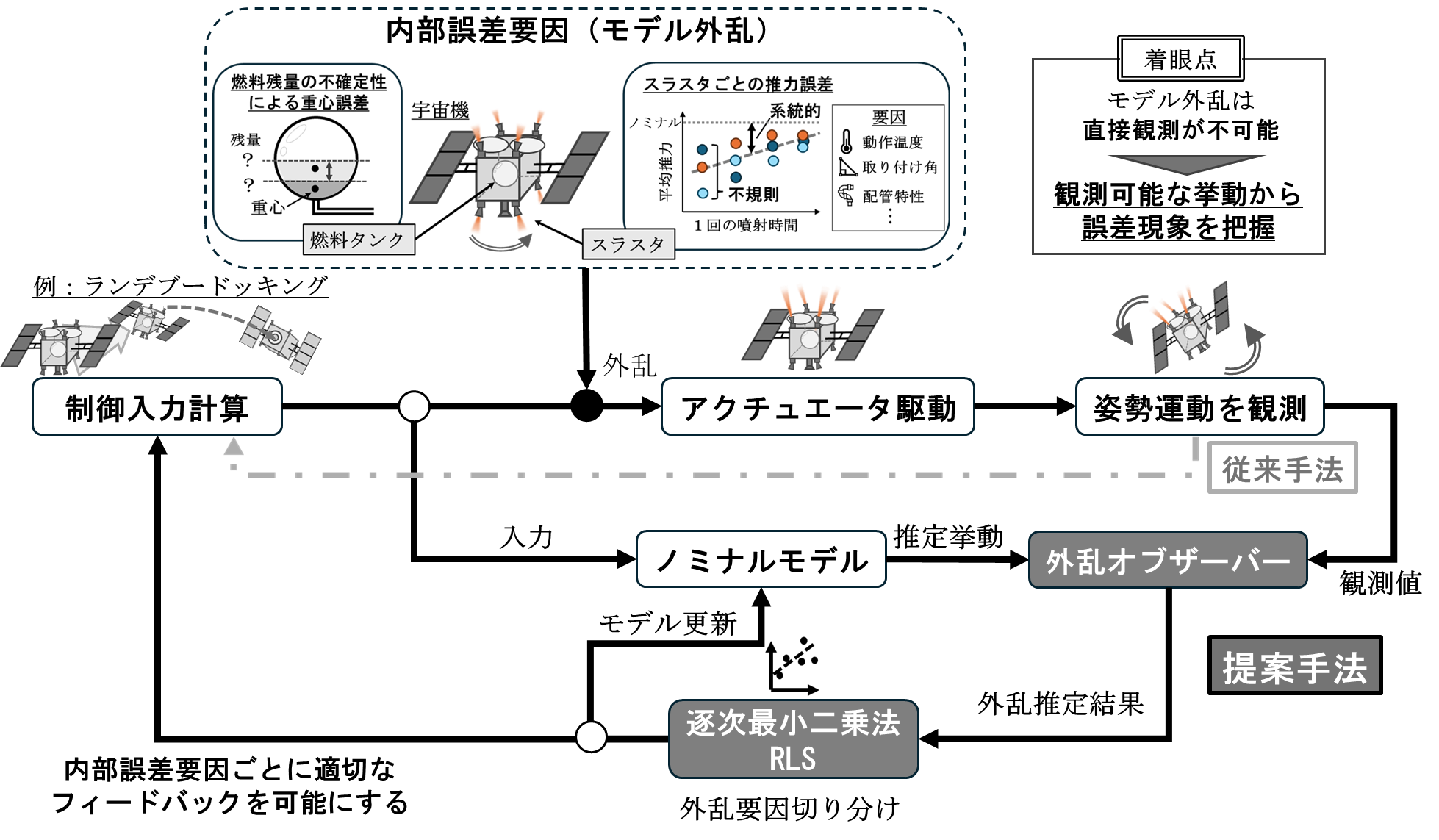
本研究では,機体の重心やスラスタ出力の誤差など,宇宙機に内在する複雑な誤差を「動き」から推定し,リアルタイムに修正する,自律制御技術の確立を目指している.地上からの指示を待たずに機体自らが誤差の原因を特定して補償することで,複雑で精密な宇宙ミッションを支えるコア技術となることを目指す.
This research aims to establish an autonomous control technology that estimates the complex errors inherent in a spacecraft—such as offsets in the center of mass and thruster output errors—from its own motion and corrects them in real time. By having the spacecraft itself identify and compensate for the sources of error without waiting for commands from the ground, we aim to provide a core technology that supports complex and precise space missions.
Abstract
近年,複数機が連携する宇宙ミッションの中で,精密な協調制御の重要性が高まっている.しかし,機体内の燃料移動による重心のズレやエンジン(スラスタ)の出力誤差といった「モデル外乱」と呼ばれる予測困難な要因が,正確なコントロールを妨げる壁となる.これらの要因は複雑に重なり合っており,これまでは正確な把握が困難であった.
本研究では,機体自らが観測できる姿勢運動(回転や傾き)から,誤差の正体を突き止める自律制御技術を確立する.まず「外乱オブザーバ」によって機体に生じている誤差の総量を素早く把握し,さらに「逐次最小二乗法」を組み合わせることで,その原因が重心のズレなのかエンジンの性能差なのかを瞬時に切り分けて推定する.
この手法は計算コストが非常に低いため,能力の限られた機上コンピュータでもリアルタイムな処理が可能である.地上の指示を待たず,機体自らが原因を特定して即座に動きを修正(能動的補償)することで,深宇宙空間でも信頼性の高い精密制御を可能にする.
In recent years, the importance of precise cooperative control has been growing in space missions in which multiple spacecraft work together. However, hard-to-predict factors known as "model disturbances"—such as a shift in the center of mass caused by fuel movement inside the vehicle, or output errors of the engines (thrusters)—form a barrier that hinders accurate control. These factors are intertwined in a complex manner, and grasping them accurately has so far been difficult.
This research establishes an autonomous control technology that pinpoints the true nature of these errors from the attitude motion (rotation and tilt) that the spacecraft can observe by itself. First, a "disturbance observer" rapidly captures the total amount of error acting on the vehicle, and then, by combining it with "recursive least squares," the cause is instantly distinguished and estimated—whether it is a shift in the center of mass or a difference in engine performance.
Because this method has a very low computational cost, real-time processing is possible even on an onboard computer with limited capability. By having the spacecraft itself identify the cause and immediately correct its motion (active compensation) without waiting for ground commands, highly reliable precision control is made possible even in deep space.